
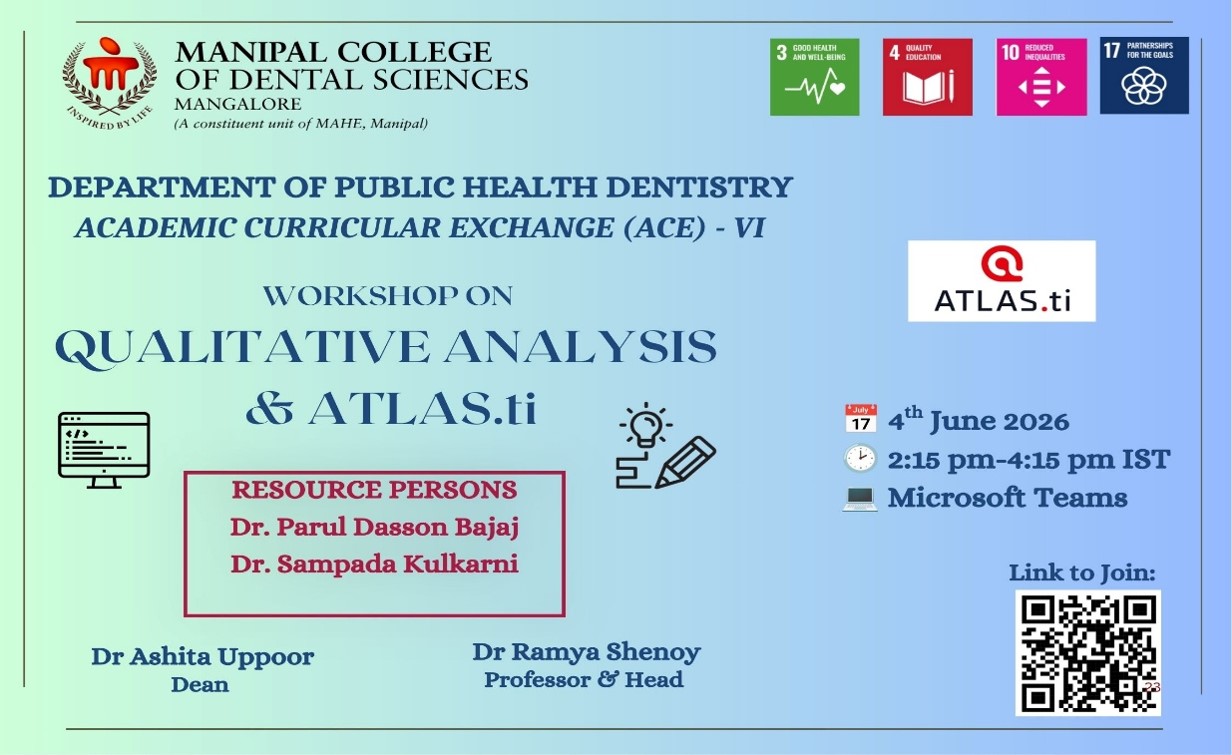
This online workshop on "Qualitative Analysis and ATLAS.ti" was held on the 4th of June 2026 was sixth in the series of Academic Curricular Exchange programs (ACE-VI), organized by the Department of Public Health Dentistry, MCODS Mangalore. The session brought together participants from India and Nepal and covered key concepts of qualitative research along with a practical demonstration of ATLAS.ti for data coding and thematic analysis.
This initiative promoted collaborative learning, research capacity building and cross-institutional academic engagement
Agenda: The workshop was structured to provide a comprehensive learning experience through a combination of lectures and hands-on practice. The agenda included the following segments:
1. Welcome Address: The event commenced with a warm welcome address by Dr. Ramya Shenoy, Professor and Head of the Department of Public Health Dentistry. Dr. Shenoy highlighted the significance of qualitative research in gaining in-depth insights and encouraged participants to make the most of the workshop.
2. Lecture on Qualitative Research Methods: : Dr. Parul Dasson Bajaj delivered a detailed lecture on the fundamentals of qualitative research and data analysis. The session covered key qualitative methodologies, theoretical approaches, coding concepts and the process of thematic analysis, providing participants with a comprehensive understanding of qualitative data interpretation.
3. Demonstration of ATLAS.ti for Qualitative Data Analysis: Dr. Sampada Kulkarni delivered a demonstration session of ATLAS.ti for qualitative data analysis. The session introduced participants to the software interface,its applications in qualitative research and the process of coding and organizing qualitative data, along with an overview of network analysis and best practices in thematic analysis.
4. Interactive Discussions: The workshop encouraged active participation through interactive discussions. Participants had the opportunity to ask questions, share insights, and clarify doubts related to the lecture and hands-on session.
The event was well-received, with attendees expressing their satisfaction with the informative lectures and demonstration. The workshop not only contributed to the professional development of the participants but also fostered meaningful interactions and collaborations among researchers from diverse backgrounds. The organizers and participants alike considered the workshop a success in promoting qualitative research excellence.